Updated: July 2026
Phinisi Factory — The Heritage of Sulawesi Boat Builders: A UN…
Phinisi Factory is a curated Indonesia luxury tourism experience offered by Phinisi Factory: handpicked routes, vetted operators, transparent pricing, and 24/7 concierge support across Indonesia.
- What makes Phinisi Factory a premium experience.
- How Phinisi Factory curates exclusive access and concierge logistics.
- Routes, seasons, and pricing transparency — no hidden fees.
The Heritage of Sulawesi Boat Builders: A UNESCO Living Legacy
On the sun-drenched shores of South Sulawesi, a maritime legacy centuries in the making continues to thrive. This is the world of the Konjo people, whose mastery of shipbuilding was inscribed as a UNESCO Intangible Cultural Heritage of Humanity in 2017. It is a tradition built not on blueprints, but on intuition, ritual, and knowledge passed through generations. At Phinisi Factory, we are privileged to be custodians of this art, blending this profound heritage with the exacting standards of modern naval architecture.
The Konjo Tribe: Custodians of a Maritime Dynasty
The story of the phinisi is inseparable from the people who build it: the Konjo tribe of Bulukumba, a regency located a 150-kilometer drive southeast of Makassar. For centuries, this community has been the beating heart of Indonesia’s maritime history, their identity forged by the sea and the forests that provide timber. They are not merely shipwrights; they are inheritors of an ancestral trust. Skills are passed from father to son, from a master boat builder (*punggawa*) to his 2 to 5 apprentices, on the very beaches where the ships take form.
This generational transfer of knowledge is profound, encompassing everything from selecting ironwood trees over 50 years old to understanding the wood’s language as it is shaped by hand. The Konjo relationship with their craft is holistic, with five distinct rituals marking key construction stages, viewing each vessel as a living entity. This deep cultural embedding, a union of human skill, natural materials, and spiritual blessing, is precisely what UNESCO sought to protect and celebrate.
Ara, Lemo Lemo, and Tana Beru: The Cradle of Phinisi Shipbuilding
The phinisi tradition is geographically anchored in a trio of villages within a 20-kilometer stretch of the Bulukumba coastline, each with a specialised role. The village of Ara is traditionally known as the home of the naval architects and constructors; it is here that the hull takes shape. In nearby Lemo Lemo, artisans historically took over, specialising in the intricate finishing work. Finally, Tana Beru serves as the primary hub where the entire process culminates.
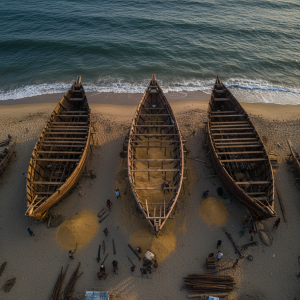
Tana Beru stands as the most renowned centre, a sprawling coastal shipyard where one can see up to 20 phinisi in various stages of construction. Walking its shores is a journey back in time, with colossal wooden skeletons of yachts, some reaching over 40 meters in length, rising from the sands. The air is thick with the scent of sawdust and the percussion of adzes striking timber. This coastal strip is the physical and spiritual home of phinisi shipbuilding, where the world’s most magnificent wooden vessels are born.
From Spice Trade to Luxury Charters: The Phinisi’s Evolution
The iconic phinisi schooner did not begin as a vessel of leisure. Its ancestors were robust cargo ships, workhorses that powered inter-island trade, capable of carrying over 100 tons of goods. They carried spices and timber, forming the logistical backbone of Sulawesi’s maritime kingdoms. Their design, with its distinctive gaff-ketch rig featuring seven sails in total, was perfected for archipelago’s unique sea conditions, making them both resilient and surprisingly swift.
Beginning in the late 1980s, a transformation began as entrepreneurs saw the potential to convert these sturdy vessels into platforms for luxury tourism. Hulls once filled with cloves were reimagined as floating villas, with a modern 35-meter phinisi costing upwards of $2 million to construct. This evolution demanded a new synthesis: the Konjo’s time-honoured hull construction combined with modern marine engineering, navigation systems, and the five-star amenities, like 6-8 en-suite cabins, expected by a discerning global clientele.
The Art of Instinct: Traditional Boat Building Techniques
What truly sets phinisi construction apart is the absence of formal blueprints. A team of 10 to 20 craftsmen, led by a master builder (*punggawa*), holds the design in their minds, taking 12 to 24 months to complete a vessel. The process is a remarkable display of instinct and intuition. Construction begins with the keel, followed by the hull planking—a ‘plank-first’ method that is the reverse of most Western ‘frame-first’ traditions. The hull is formed first, and only then are internal frames inserted to reinforce it.
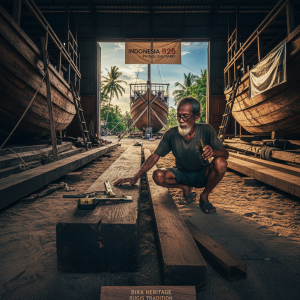
The tools used are often as traditional as the methods. While modern power tools have been adopted for efficiency, the essential shaping is still done by hand with the *kapak* (axe), *pahat* (chisel), and *bor* (hand drill). Wooden dowels, not metal nails, are often used to fasten the main planks, allowing the hull to flex in heavy seas. This organic approach, where the builder feels and responds to the character of each piece of wood, results in a vessel that is not merely assembled but brought to life.
Spiritual and Ritualistic Dimensions of Shipbuilding
To the Konjo, building a phinisi is a deeply spiritual act. A series of rituals and ceremonies are performed throughout the construction process to ensure the vessel’s safety, prosperity, and harmony with the sea. It begins with selecting the timber, often involving offerings to the forest spirits. A significant ceremony marks the laying of the keel, where the *lunas* is positioned to face the northeast, a direction of good fortune.
Before the final plank is laid, a ceremony called *Annyorong Lopi* (pushing the boat) takes place, involving the entire community. This elaborate ritual includes sacrificing an animal, with the blood being symbolically smeared on the hull to give the boat its spirit or “soul.” These practices underscore the belief that the phinisi is more than an object; it is a living being, born of the land and destined for the sea, and must be treated with commensurate respect.
Phinisi Factory: Honouring Tradition, Engineering for the Future
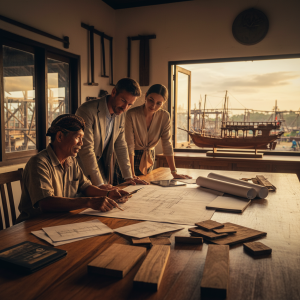
At Phinisi Factory, we have built our philosophy around a deep and authentic respect for this UNESCO-recognised heritage. We do not seek to replace tradition but to enhance it. Our process is a partnership, uniting the irreplaceable instinct of Konjo master builders from Tana Beru with the rigorous discipline of international naval architecture, safety classifications, and marine engineering. We see ourselves as facilitators, providing the framework for this ancient craft to meet the demands of the 21st century.
Our commitment extends beyond the build itself. We ensure that the economic benefits flow back into the Bulukumba communities, supporting the families who are the true custodians of this legacy. By commissioning a vessel with Phinisi Factory, our clients are not just acquiring a top-tier yacht; they are becoming patrons of a living art form, ensuring that the sound of the adze on ironwood will continue to echo along the shores of South Sulawesi for generations to come.
Commission a Piece of Living History
The legacy of the Sulawesi boat builders offers a foundation of exceptional authenticity and soul for a modern luxury vessel. To explore how this heritage can inform the creation of your own bespoke phinisi yacht, we invite you to begin a conversation with our specialist team. Please make contact via email at [email protected] or on WhatsApp at +62 811-3823-875 to discuss your vision.
Frequently Asked Questions
What is a phinisi?
A phinisi is a traditional two-masted Indonesian sailing ship, originally used for cargo and trade throughout the archipelago. Today, the term refers to vessels built in the traditional style of the Konjo people of South Sulawesi, but often outfitted as luxury charter yachts, dive boats, or private residences. The iconic gaff-ketch rig and hand-built wooden hull are its defining features.
Why is phinisi shipbuilding recognised by UNESCO?
In 2017, the “Art of Boatbuilding in South Sulawesi” was inscribed on the UNESCO Representative List of the Intangible Cultural Heritage of Humanity. The recognition celebrates the entire body of knowledge, skills, rituals, and social practices of the Konjo boat builders, which are passed down through generations without formal blueprints, representing a living and invaluable maritime tradition.
Who are the Konjo boat builders?
The Konjo people are an ethnic group from the Bulukumba regency in South Sulawesi, Indonesia, who are globally renowned for their mastery of wooden shipbuilding. For centuries, they have been the primary builders of phinisi and other traditional vessels. Their skills are learned through direct apprenticeship and are deeply interwoven with their cultural and spiritual beliefs, making them the custodians of this unique heritage.
Where is the Tana Beru shipyard?
Tana Beru is a coastal village located in the Bontobahari district of Bulukumba, South Sulawesi. It is widely regarded as the epicentre of phinisi construction. The entire beachfront of Tana Beru functions as an open-air shipyard, where dozens of massive wooden vessels can be seen in various stages of construction right on the sand, offering a spectacular insight into this traditional industry.
Are traditional phinisis built without blueprints?
Yes, traditionally, the entire design and construction process is guided by the experience and intuition of the *punggawa*, or master boat builder. He holds the complex dimensions, ratios, and structural plans in his mind. This method relies on generations of accumulated knowledge about the properties of wood and the dynamics of the sea, resulting in incredibly seaworthy and unique vessels.
What kind of wood is used to build a phinisi?
The primary timbers used are tropical hardwoods known for their strength and durability in a marine environment. Ironwood (*kayu ulin*) is highly prized for the keel and main structural components due to its incredible density and resistance to rot. Teak (*kayu jati*) is often used for the decking and superstructures because of its stability and beautiful finish. The specific choice of wood is a critical decision made by the master builder.
How long does it take to build a luxury phinisi?
The construction of a luxury phinisi is a meticulous process. A vessel between 35 to 50 metres in length typically takes 18 to 24 months to complete. This timeline includes the traditional hull construction on the beaches of Sulawesi, followed by the technical installation of engines, systems, and the detailed interior finishing, which often takes place at a more modern facility.
How does Phinisi Factory integrate modern standards?
Phinisi Factory acts as a bridge between ancient craftsmanship and modern requirements. We engage Konjo masters for the traditional hull construction, honouring their techniques. Simultaneously, our naval architects and engineers oversee the process to ensure the vessel meets international safety standards (such as RINA or BKI class), stability requirements, and incorporates modern propulsion, navigation, and hotel systems for a top-tier yachting experience.
What are the spiritual rituals in phinisi building?
Shipbuilding is a sacred act for the Konjo. It involves a series of ceremonies to appease spirits and ensure good fortune. Key rituals include the laying of the keel (*lunas*), the insertion of the main frames, and the *Annyorong Lopi* launching ceremony, which involves a symbolic sacrifice to give the boat its “soul.” These rituals are considered essential for the vessel’s safety and success at sea.
Can I customise my own phinisi yacht?
Absolutely. While the hull construction follows time-honoured traditions, the entire general arrangement, interior design, and outfitting are fully bespoke. Clients work closely with our design team to create a phinisi that reflects their specific needs, whether for private family use, a commercial charter operation, or a specialised dive expedition vessel. Every interior detail, from cabin layout to material selection, is tailored to the owner’s vision.
Is a phinisi the same as a yacht?
While modern phinisis function as luxury yachts, they are a distinct category of vessel. The term “yacht” is broad, but “phinisi” specifically refers to a vessel built in the traditional Indonesian style with its characteristic hull shape and two-masted schooner rig. A phinisi is a type of yacht, but one with a unique cultural identity and a construction heritage that sets it apart from typical fibreglass or steel motor yachts.