Updated: July 2026
Phinisi Factory — The Definitive Guide to the Phinisi Boat Bui…
Phinisi Factory is a curated Indonesia luxury tourism experience offered by Phinisi Factory: handpicked routes, vetted operators, transparent pricing, and 24/7 concierge support across Indonesia.
- What makes Phinisi Factory a premium experience.
- How Phinisi Factory curates exclusive access and concierge logistics.
- Routes, seasons, and pricing transparency — no hidden fees.
The Definitive Guide to the Phinisi Boat Building Process
From the sun-drenched shores of Bira, a coastal town some 200 kilometers from Makassar in South Sulawesi, a centuries-old maritime legacy is reborn. The phinisi, an icon of Indonesian seafaring recognized by UNESCO in 2017, represents a pinnacle of traditional naval craftsmanship. This guide details the intricate journey of a phinisi’s creation, from initial concept to its triumphant launch. At Phinisi Factory, we honour this heritage, meticulously blending ancestral techniques with the exacting standards of modern luxury yacht construction to create vessels of exceptional character and capability.
The Genesis: Design and Consultation
Every phinisi begins not with timber, but with a vision. The initial stage is an in-depth consultation, a collaborative dialogue between the client, our naval architects, and our master builders. This is where aspirations—be it a private family yacht or a high-yield charter vessel targeting a 12% annual return—are translated into a coherent design brief. We explore operational requirements, guest capacity, a cruising range of over 2,500 nautical miles, and aesthetic preferences, ensuring the final vessel is perfectly aligned with its intended purpose.
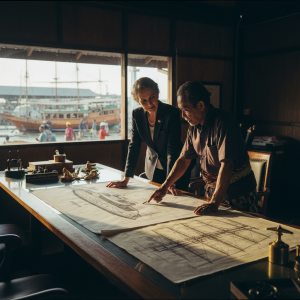
Using advanced CAD software like Rhino 3D, we develop detailed schematics, general arrangements, and 3D renderings that adhere to international maritime standards like RINA classification. Yet, this modern precision is always tempered by the wisdom of the Konjo shipwrights. The lines of the hull, the balance of the rig, and the inherent seaworthiness of the design are scrutinised through a lens of inherited knowledge. This fusion of contemporary engineering and ancestral intuition ensures each vessel is not only beautiful and luxurious but also fundamentally sound and safe.
The Soul of the Ship: Keel Laying and Frame Construction
The first physical step in a phinisi’s life, kicking off a build process that can last 18 to 24 months, is steeped in profound ritual. The keel laying ceremony, or Annyorong Lopi, is a spiritual and communal event that marks the true beginning. Led by the master builder, the panrita lopi, prayers are offered and symbolic offerings, often including the blood of a chicken, are made to seek blessings for the vessel and its future crew. This ceremony connects the build to the cultural bedrock of South Sulawesi, imbuing the ship with a soul from its very inception.
Following the ceremony, the real work begins. The keel, often a single piece of ironwood (kayu ulin) over 20 meters long, is laid upon the shores of Bira. This formidable timber has a density exceeding 1.0 g/cm³, making it one of the few woods that sinks in water. From this backbone, the ribs of the ship are meticulously shaped and raised. Builders work not from printed blueprints but from a mental map, a system of proportions passed down through generations. Each frame is hand-carved, creating the strong skeleton that defines the phinisi’s form.
Forming the Vessel: Hull Planking and Decking
With the framework complete, the vessel begins to take its recognisable shape. The process of planking the hull is a masterclass in joinery. Planks of ironwood from Kalimantan and bitti wood, often up to 7 cm thick, are chosen for their durability and resistance to marine borers. These are heated, bent, and coaxed into place. In the traditional method, the planks are joined using thousands of wooden dowels, a technique that allows the hull to flex with the sea, rather than fight it.
The seams between the planks are then painstakingly caulked, a process that can take a team of specialists up to 4 weeks. Strips of bark from the gelam tree are hammered into the gaps, creating a natural, waterproof seal that swells when wet. This ancient method remains remarkably effective. Above the waterline, modern sealants are employed, before the decking is laid. This provides the platform for the superstructure and over 200 square meters of the expansive, open deck space that is a hallmark of a luxury phinisi.
The Art of Propulsion: Masts, Spars, and Rigging
A phinisi is defined by its majestic seven-sail schooner rig, which can carry a total sail area of over 600 square meters. The two masts, traditionally representing the two sentences of the Islamic creed, are sourced from single, towering trees, with the mainmast often rising more than 30 meters above the deck. Shaping these masts and their associated spars is a specialised skill, ensuring they possess immense strength and the correct balance. They are the engines of the ship, designed to harness the power of the Indonesian archipelago’s winds.
The installation of the standing and running rigging is a complex dance of ropes, blocks, and tackles. While the configuration of the traditional rigging is preserved for its aesthetic and historical power, the Phinisi Factory integrates modern materials and hardware. High-tensile stainless steel wire, durable synthetic ropes, and modern winches are discreetly incorporated to enhance safety, reliability, and ease of handling for a modern crew, without compromising the vessel’s classic silhouette.
The Modern Heart: Engine, Systems, and Interior Finishing
Once the traditional structure is complete, the phinisi transitions into a modern superyacht. This is one of the most complex shipyard stages, demanding a different set of skills. The engine room is fitted out with reliable marine diesel engines, generators, water makers, and air conditioning systems. Teams of electricians and plumbers lay kilometres of wiring and piping, installing navigation equipment, communication systems, and hotel-grade plumbing to ensure five-star comfort at sea.
The art of yacht finishing in Indonesia comes to the fore as the interior spaces are created. Our clients work with interior designers to craft bespoke environments, from opulent master suites to comfortable guest cabins and elegant saloons. We commission local artisans, particularly from the famed furniture-making centre of Jepara, to create custom teak cabinetry and furnishings. This stage transforms the raw wooden hull into a top-tier luxury retreat.
The Final Voyage: Launch, Sea Trials, and Handover
The launch of a phinisi is a spectacular community celebration. The entire village often gathers to help push the massive vessel across the sand and into the sea for the first time. It is a moment of immense pride and the culmination of thousands of hours of skilled labour. Once afloat, the vessel is moved to a finishing dock where the final touches are applied and the masts are stepped.
Before handover, the vessel undergoes a rigorous series of sea trials. Every system—from the engines and navigation electronics to the sails and safety equipment—is tested under real-world conditions to ensure flawless performance. This is a critical quality assurance step in the phinisi construction timeline. Upon successful completion, the yacht is formally handed over to its owner, complete with all documentation, classification certificates, and crew training, ready to begin its new life exploring the archipelago.
Begin Your Phinisi Journey
Commissioning a phinisi is more than a purchase; it is the creation of a legacy. If you are ready to explore the process of building your own custom vessel, our team is available to provide a detailed consultation. Contact our business development team to discuss your vision at [email protected] or via WhatsApp at +62 811-3823-875.
Frequently Asked Questions
What is a realistic phinisi construction timeline?
A custom-built luxury phinisi typically takes between 18 to 24 months from contract signing to final handover. The initial phase involves detailed design and naval architecture, which can take 2-4 months. The hull and structural work in Bira usually require 12-15 months. The final stage of interior finishing, systems installation, and sea trials takes an additional 6-8 months. The complexity of the interior design and technical systems are the primary variables affecting the overall timeline.
What are the primary timbers used in construction?
The soul of a phinisi lies in its timber. For the keel and hull planking below the waterline, we exclusively use Ironwood (Kayu Ulin), renowned for its extreme density and near-imperviousness to marine borers. For frames and the upper hull, Bitti (Kayu Bitti) is often used for its strength and workability. For the superstructure, decking, and interior finishing, we primarily use high-grade, sustainably sourced teak for its beauty, durability, and weather resistance.
Who is the ‘panrita lopi’ and what is their role?
The ‘panrita lopi’ is the master boat builder, a figure of immense respect within the Konjo community of South Sulawesi. This is not merely a job title but a spiritual and practical authority. The panrita lopi leads all traditional aspects of the build, from the keel-laying ceremony to overseeing the hull construction, working from memory and inherited knowledge rather than written plans. They are the custodians of the phinisi’s authentic form and spirit.
How is a modern phinisi different from a traditional one?
While the hull shape and rigging are traditional, a modern luxury phinisi is a hybrid vessel. Traditionally, phinisis were pure sailing cargo ships with no engine and basic crew quarters. Today’s vessels incorporate powerful marine engines, generators, advanced navigation systems, water makers, and full air-conditioning. The interiors are finished to superyacht standards with en-suite cabins, gourmet galleys, and sophisticated entertainment systems, offering a level of comfort and safety unimaginable to their ancestors.
Can a phinisi be built to international classification standards?
Yes, absolutely. While the build begins with traditional methods, we work closely with international classification societies like RINA or Bureau Veritas from the design phase onwards. Surveyors make regular visits to the shipyard in Bira and the finishing facility to inspect the build quality, materials, and systems installation. This ensures the final vessel meets global standards for safety, construction, and insurance purposes, making it a viable commercial charter asset.
What is involved in the ‘yacht finishing’ stage in Indonesia?
Yacht finishing is where the vessel is transformed from a robust hull into a luxury product. After the traditional build in Bira, the phinisi is typically moved to a facility in Bali or Java. Here, specialist teams install all the modern systems: engines, electrics, plumbing, and navigation. Simultaneously, master craftsmen work on the interior, installing custom-milled teak joinery, fine upholstery, stone countertops, and high-end fixtures to create a bespoke, five-star environment.
Are the building materials sourced sustainably?
Sustainability is a core principle. We are committed to responsible sourcing for all our timber. The ironwood and teak we use are sourced from government-managed forests and suppliers who can provide verifiable chain-of-custody documentation (SVLK certification). This ensures that the construction of your vessel contributes positively to the responsible management of Indonesia’s precious natural resources, protecting the environment that these magnificent boats are built to explore.
What happens during sea trials?
Sea trials are the final, critical validation phase. Over several days, we test every aspect of the phinisi’s performance and systems in open water. We run the engines at various speeds, test manoeuvrability, and check fuel consumption. We hoist all sails to assess balance and performance under wind power. All onboard systems, from the anchor winch and navigation equipment to the air conditioning and galley appliances, are operated extensively to identify and resolve any issues before final handover.
How much customisation is possible in the design?
The level of customisation is virtually limitless. The process begins with a blank page. Clients dictate the general arrangement, including the number and configuration of cabins, the layout of the saloon and deck spaces, and the specific operational capabilities. The interior design is entirely bespoke, allowing for a unique choice of materials, colour palettes, furniture, and art. The Phinisi Factory’s role is to guide these choices to ensure they are integrated within a structurally sound and seaworthy design.
Why build a phinisi in Bulukumba?
Bulukumba, and specifically the beach of Bira, is the geographic and spiritual home of phinisi construction. This is where the knowledge, passed down through countless generations of the Konjo people, resides. Building here allows us to engage directly with the most experienced panrita lopi and shipwrights. It ensures the vessel is imbued with the authentic spirit and time-honoured techniques that simply cannot be replicated anywhere else in the world. It is the only place to build a true phinisi.